

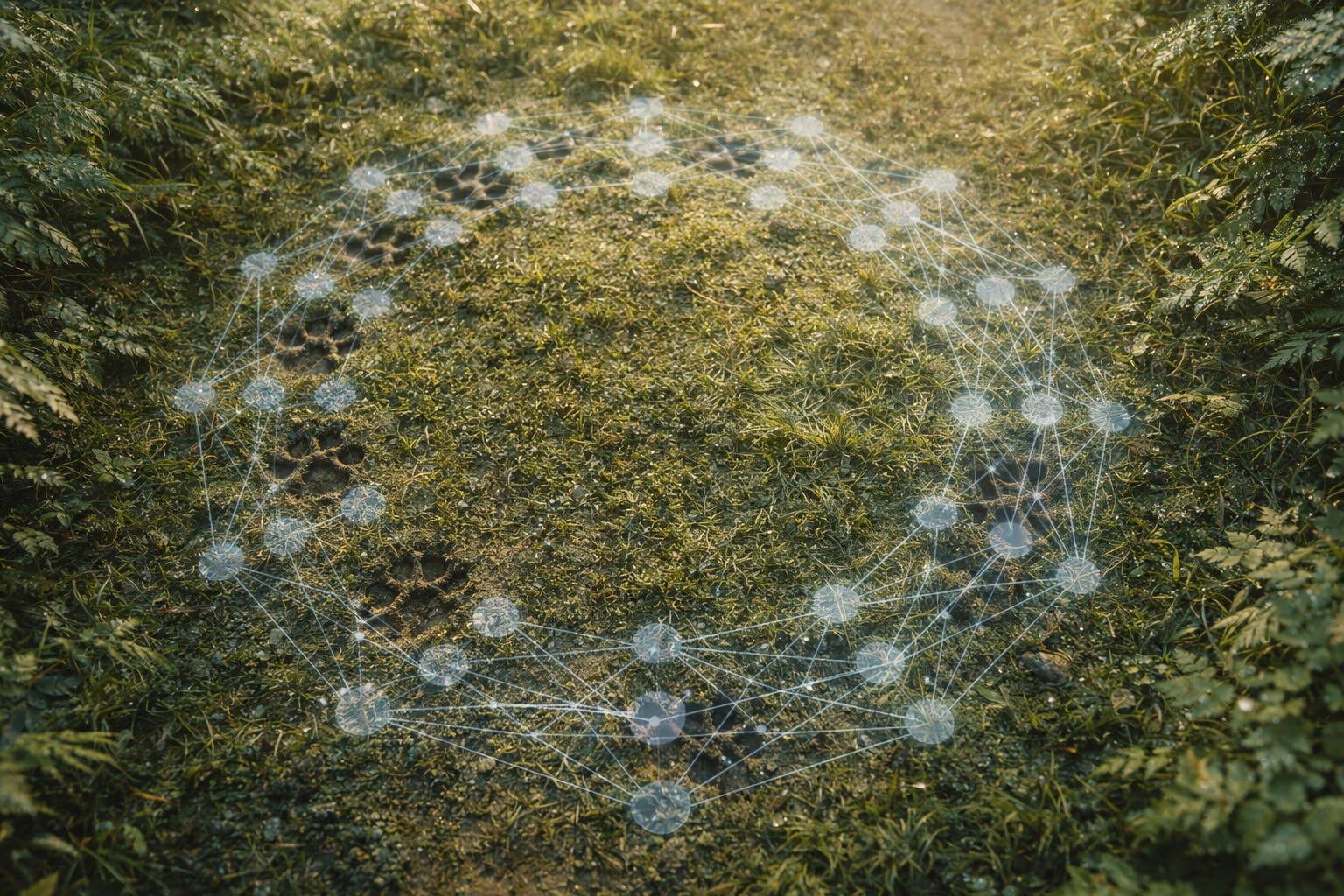
Gracie found the scent again this morning. Same patch of grass, same obsessive circling, same conviction that the deer or rabbit she smelled there three days ago might still be waiting. I’ve watched my golden retriever copilot do this a hundred times on our early morning walks – past signal, possible reward, investigate again – and it never changes. She trusts the pattern completely.
At the same time I was on my phone working through a strategic question out loud with ChatGPT. At one point, the model responded by pointing out that I was relying heavily on pattern matching to reach my conclusion.
That caught me a little off guard. Pattern matching, after all, is one of the things that frustrates me most about these AI models. It’s the engine behind the hallucinations, the confident wrong answers, the moments where a model completes a pattern with something plausible rather than something true and presents it like settled fact. It’s also, to be fair, the thing behind the responses that feel almost unreasonably good – the leaps that land precisely because the model connected dots you hadn’t seen yet. I’ve complained about the misses more times than I can count. And here was the AI telling me I was doing the very thing that frustrates me most about it.
But standing there on a dirt path watching Gracie investigate that same patch of grass for the third time, I had to sit with an uncomfortable recognition: I was doing the exact same thing. Drawing on prior conversations, previous outcomes, familiar structures. Connecting incomplete dots and filling gaps with probability-weighted guesses. The behavior I keep criticizing in machines was running quietly underneath my own thinking the entire time. That irony was not lost on me.
Here’s the thing, though – once you see it, you can’t unsee it. And I don’t just mean in that one moment on a walk. I mean everywhere. We assume tone from phrasing in an email and act on that assumption before we’ve verified it. We predict how someone will behave based on one previous interaction. We interpret silence as intent. We build entire strategic narratives from partial information and then defend them in meetings like we arrived at them through rigorous analysis. Most of the time we call this intuition or gut instinct. Sometimes, if we’re being honest, it’s just a really confident guess.
So why does it bother us so much when AI does the same thing?
I think it’s because the seams are showing. When a model makes a leap that feels slightly off, you can see it reaching – extending a pattern past where the data actually supports it. When we make the same kind of leap, it feels organic. Earned. Our patterning happens internally, wrapped in years of experience and a healthy layer of confidence. The model’s happens right out in the open where anyone can poke at it.
And honestly, that visibility is more useful than most people give it credit for.
I spend a lot of my working hours inside these tools. Building with them, stress-testing them, occasionally arguing with them. I’m building a platform called Artwell that’s rooted in the belief that AI should sharpen human storytelling rather than flatten it, so this isn’t theoretical for me – it’s the work. And the thing I didn’t expect – the thing nobody really talks about at AI conferences – is how much that daily interaction has changed the way I observe my own reasoning. Not in some grand philosophical way. In small, practical, slightly annoying ways. A model overextends on an inference, and I catch myself thinking, “Wait, didn’t I do almost exactly that in a pitch last Tuesday?” It fills in missing context with a plausible guess, and I realize I’ve been doing the same thing in emails all week without a second thought.
It’s like having a sparring partner who occasionally throws a sloppy punch and forces you to notice your own footwork isn’t as clean as you thought.
Used passively – just accepting whatever the model generates and moving on – AI absolutely reinforces lazy thinking. I’ve seen it happen. I’ve done it myself on a Thursday afternoon when I just need a first draft out the door. But used with even a little bit of intentionality, something different happens. You start noticing the gap between what you actually observed and what you concluded. You start asking yourself questions you’d normally skip: Is this conclusion real, or am I overfitting to one example? Am I projecting intent where there might just be silence? Am I mistaking familiarity for truth?
Those questions aren’t comfortable. But they’re the kind of questions that make you a sharper thinker over time. And not just analytically – the same awareness that helps you catch a bad inference in a strategy deck starts showing up in how you read a room, how you listen to a colleague who’s frustrated, how you check your own assumptions before reacting to an email that rubbed you wrong. It shows up at the dinner table when your kid says something that irritates you and you catch yourself mid-reaction, realizing you’re responding to a pattern from last week’s argument, not to what they’re actually saying right now. When you get in the habit of interrogating your own pattern matching, it doesn’t stay contained to work. It changes how you show up for the people around you.
Maybe that shouldn’t surprise us. Humans built these systems, after all. We modeled them on how we process language and probability and context. But somewhere along the way, most of us forgot that the resemblance runs both directions. AI wasn’t designed to think like a strange alien intelligence. It was designed to think like us – and the reflection it sends back, if you’re willing to look at it honestly, is more revealing than most of us expected.
The broader AI conversation right now is almost entirely about capability – what models will generate next, how fast they’ll scale, which jobs they’ll absorb. And look, I get it. That’s where the money is, and it’s where the anxiety is. But there’s a quieter shift happening underneath that nobody’s writing breathless LinkedIn posts about. As these systems become embedded in how we brainstorm, plan, and make decisions, they’re externalizing something humans have always kept hidden: the mechanics of how we actually think. They’re making it harder to pretend that what we call logic isn’t mostly structured probability. That what we call certainty isn’t compressed experience. That what we call judgment isn’t, at its core, sophisticated guesswork refined over time.
Gracie doesn’t question why she keeps returning to that same patch of grass. The pattern works often enough. She trusts it. Honestly, most days, humans aren’t that different – we’ve just built more elaborate narratives around our version of sniffing the same spot.
AI isn’t replacing thinking. It’s showing us what thinking actually looks like under the hood. And for those of us willing to sit with that instead of flinching from it, the real gift isn’t efficiency or automation. It’s the chance to become more deliberate, more honest, and maybe a little more human in how we use the minds we’ve had all along.
The next time you catch yourself making a confident assumption – in a meeting, in an email, in a conversation with someone you love – pause for a second. Ask yourself where the pattern came from. You might be surprised how often the answer is worth examining.
Tomorrow morning, I think I’ll take Gracie down a different trail. Same nose, same instincts – just new ground. She’ll have to trust the patterns she already knows in a place they’ve never been tested. Come to think of it, that makes two of us.