

When I was a kid I had a black-and-white photo of Bruce Lee pinned to my bedroom mirror. I was fat. I got picked on. And every morning I woke up and looked at a man who the world underestimated until they couldn’t anymore.
I didn’t care about the kicks. I cared about the philosophy.
Bruce Lee studied every martial art he could find, and then he threw them all away. Not because they were worthless. Because they had become more important than the fight itself. The forms were beautiful. The katas were precise. And they would get you killed, because they trained you to follow a pattern instead of responding to what was actually in front of you.
But here’s what most people leave out of that story. He didn’t walk away from nothing. He mastered Wing Chun under Ip Man. He studied Western boxing, fencing, judo, wrestling, grappling, taekwondo. He didn’t reject discipline – he completed it. Jeet Kune Do wasn’t the absence of form. It was what came after mastery of form. The formless form. And that distinction matters, because anyone can tear up a playbook. Only someone who has mastered the playbook earns the right to replace it with something better.
He replaced all of it with one principle. He inscribed it on the Jeet Kune Do symbol in Chinese characters:
Using no way as way. Having no limitation as limitation.
The whole world remembers “be like water.” Almost nobody remembers what he actually meant. He wasn’t talking about style. Everybody gets that wrong. He was talking about form. Rigid form. He was warning against it. The kind of form that looks powerful in a controlled environment and shatters the second reality shows up unannounced.
I’ve been thinking about this a lot lately. Because the AI industry is building nothing but form.
The Industry Is Performing Kata
Every major company deploying AI right now is performing kata.
Choreographed sequences. Executed the same way every time. There’s a transformation roadmap. A change management framework. An all-hands where a senior leader says the words “more productive.” A polished internal memo. An external campaign.
Beautiful choreography.
Adoption goes up 13%. Trust goes down 18%. 77% of employees say AI increased their workload. 56% of companies report zero financial return. 59% of hiring managers admit they dress layoff announcements in AI language because it plays better than telling the truth.
I Watched This Happen From the Inside
I spent almost twenty years inside Microsoft. I watched this happen in real time. Not once. Over and over. The playbook kept running even after reality had moved on. The structure was still standing, the choreography was still being performed, but the truth had left the building and nobody noticed because the form was still intact.
Bruce Lee saw this exact pattern in every traditional martial art that had stopped questioning itself:
“Set patterns, incapable of adaptability, of pliability, only offer a better cage. Truth is outside of all patterns.”
– Bruce Lee
The cage is the playbook. The cage is the framework. The cage is the bolted-on narrative that tells employees AI will empower them while their colleagues disappear.
The Imitation Problem
There’s a quote from the Tao of Jeet Kune Do that I forgot for thirty years and remembered tonight.
“We have more faith in what we imitate than in what we originate. We cannot derive a sense of absolute certitude from anything which has its roots in us.”
– Bruce Lee, Tao of Jeet Kune Do
Read that again in the context of how companies are deploying AI.
Every enterprise is imitating every other enterprise. The same playbooks. The same transformation language. The same announcements. The same Copilot rollout strategy. Nobody is originating anything because originating requires trusting your own judgment about what your people actually need. And that’s terrifying when the whole industry is moving at once and nobody wants to be the one who did it differently.
So they imitate. They bolt on what worked somewhere else. And they wonder why it doesn’t work here.
“If you follow the classical pattern, you are understanding the routine, the tradition, the shadow – you are not understanding yourself.”
– Bruce Lee
That’s the AI industry’s problem in one sentence. Companies are following the classical pattern. They understand the routine. They do not understand themselves. They do not understand their own people, their own culture, their own customers, the actual lived reality of the humans who are supposed to benefit from all of this.
The Audience Has Already Left
Half of Americans say AI in daily life makes them more concerned than excited. 65% of workers barely use it. The people building AI narratives live in a bubble where everyone uses AI every day, and they assume the rest of the world is right there with them.
It isn’t.
Coca-Cola’s AI holiday ads got rejected as soulless. McDonald’s pulled their AI Christmas commercial after audiences called it slop. iHeartMedia launched a “Guaranteed Human” campaign because 9 in 10 consumers want their media made by actual people. Merriam-Webster named “slop” their word of the year.
The forms keep performing. The audience has already left.
What I’d Say If I Could Be Honest
If I could sit across from every CEO pushing AI transformation and say one honest thing, here’s what I’d say.
Your version of AI is crushing something deeply human. It’s crushing endeavor. It’s crushing dignity in work. People feel it even when they can’t articulate it, and your internal communications aren’t fooling anyone.
But here’s where most critics get it wrong, and I want to be precise.
AI is not the problem.
I use AI every waking hour. It replaced Google for me. It replaced how-to videos. It replaced a hundred small friction points. It is one of the most powerful tools I have ever used. I am building an entire company on it.
The problem is how AI has been framed, marketed, and introduced to the world. We have done a terrible job helping people understand where AI helps, where it harms, and where the line should be. And we have done an even worse job listening to what people actually need before deciding what to build and how to sell it.
Not better AI. Better honesty about AI.
Hack Away at the Inessentials
Bruce Lee didn’t build Jeet Kune Do by learning more techniques. He said it himself:
“It is not a daily increase, but a daily decrease. Hack away at the inessentials.”
– Bruce Lee
The AI industry needs to hack away at the inessentials. The theater. The hype. The fake wisdom. The obsession with scale for the sake of scale. The idea that making humans smaller somehow counts as progress.
The version of AI nobody is building toward is the one that quietly makes people stronger. Smarter.Clearer. More capable. Not more dependent. Not more passive. Not more replaceable.
Something that serves the human without swallowing the human. Powerful, but disciplined. Something that helps you move better, not disappear faster.
A formless form. Not chaos. Readiness. The ability to respond to what’s real without being locked into a pattern designed for a different fight.
The Mirror
When I was thirteen I pinned Bruce Lee to my mirror because I wanted to become something better than what I was. I was a fat kid who got picked on, and he represented the possibility that the person everyone underestimates can be the one who sees most clearly.
So I did something about it. I started training in Shotokan karate. I became a Varsity wrestler. Not because I wanted to fight anybody. Because I wanted to stop being afraid. And it worked. Not overnight, not dramatically, but in the way real things work – slowly, through repetition, through showing up when I didn’t feel like it. I lost the weight. I found confidence I didn’t know I had. I learned that discipline wasn’t something you performed. It was something you practiced until it became part of you.
That kid went on to spend twenty years at Microsoft and build a content program from nothing into something that generated $59 million in revenue. I mastered the playbook. And then I earned the right to throw it away and build something of my own. And I forgot, for a very long time, where all of it started.
I’m older now. I forgot that photo. I forgot the philosophy. I let decades of corporate life and monthly bills and other people’s priorities bury something that used to matter to me more than anything.
I’m not forgetting it again.
If I could pin something to my mirror today it would say this:
You built today. You earned tomorrow.
That’s not a Bruce Lee quote. That’s mine. But I think he’d understand it. Because it’s about the same thing he spent his whole life teaching – that truth is earned through honest work, not inherited through rigid form. And that the person willing to throw away the playbook and start from what’s real will always see further than the ones still performing kata in an empty room.
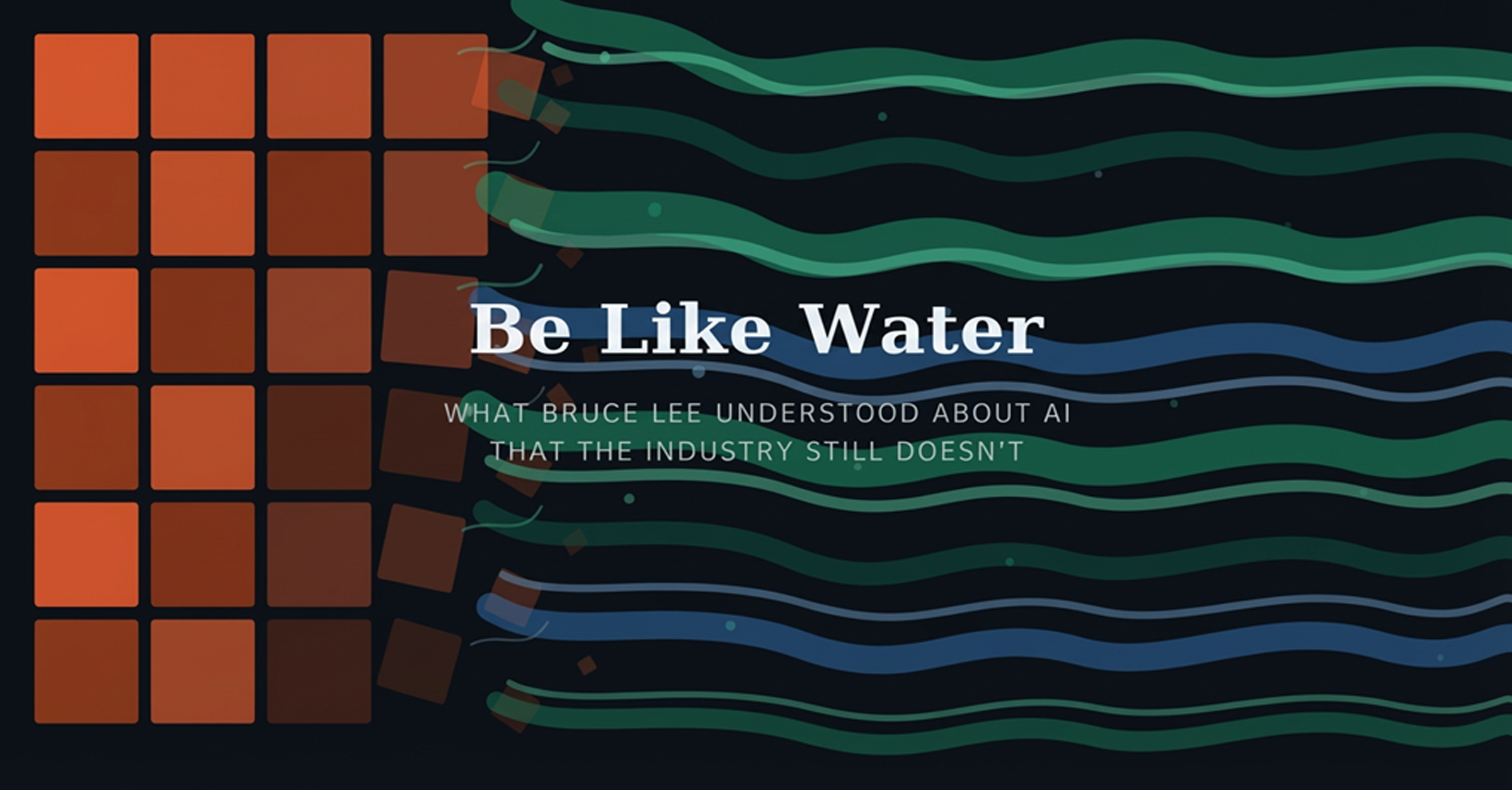
Be like water.
Bruce Bracken is the founder of Artwell.ai and former Head of Podcasts & Digital Experiences at Microsoft, where he built a content ecosystem that generated $59M in attributed Azure revenue. He writes about the gap between what AI companies say and what humans actually experience.