

Every summer delivers two things on schedule: a soul-sucking heat wave, and a monster. The most famous summer monster ever built was a mechanical shark named Bruce, after Spielberg’s lawyer – no relation, on either count – and the beautiful part is that Bruce barely worked. Salt water ate his hydraulics. He sank to the bottom of the sound on his first day in the ocean. He broke down so relentlessly that Spielberg had to shoot most of the movie without him, which, ironically, is exactly why the movie terrified the planet: two notes on a tuba and the hint of a fin emptied every beach in America. The monster almost never functioned, but the fear never broke down once.
This summer got its monster too, and it’s faithful to the original in the one way that matters: it barely needs to exist. It’s two letters long, and it bites you in the analytics.
Sometime in the last few weeks, LinkedIn started writing people up – quiet notes informing you that readers reported your post because it seemed like AI slop.
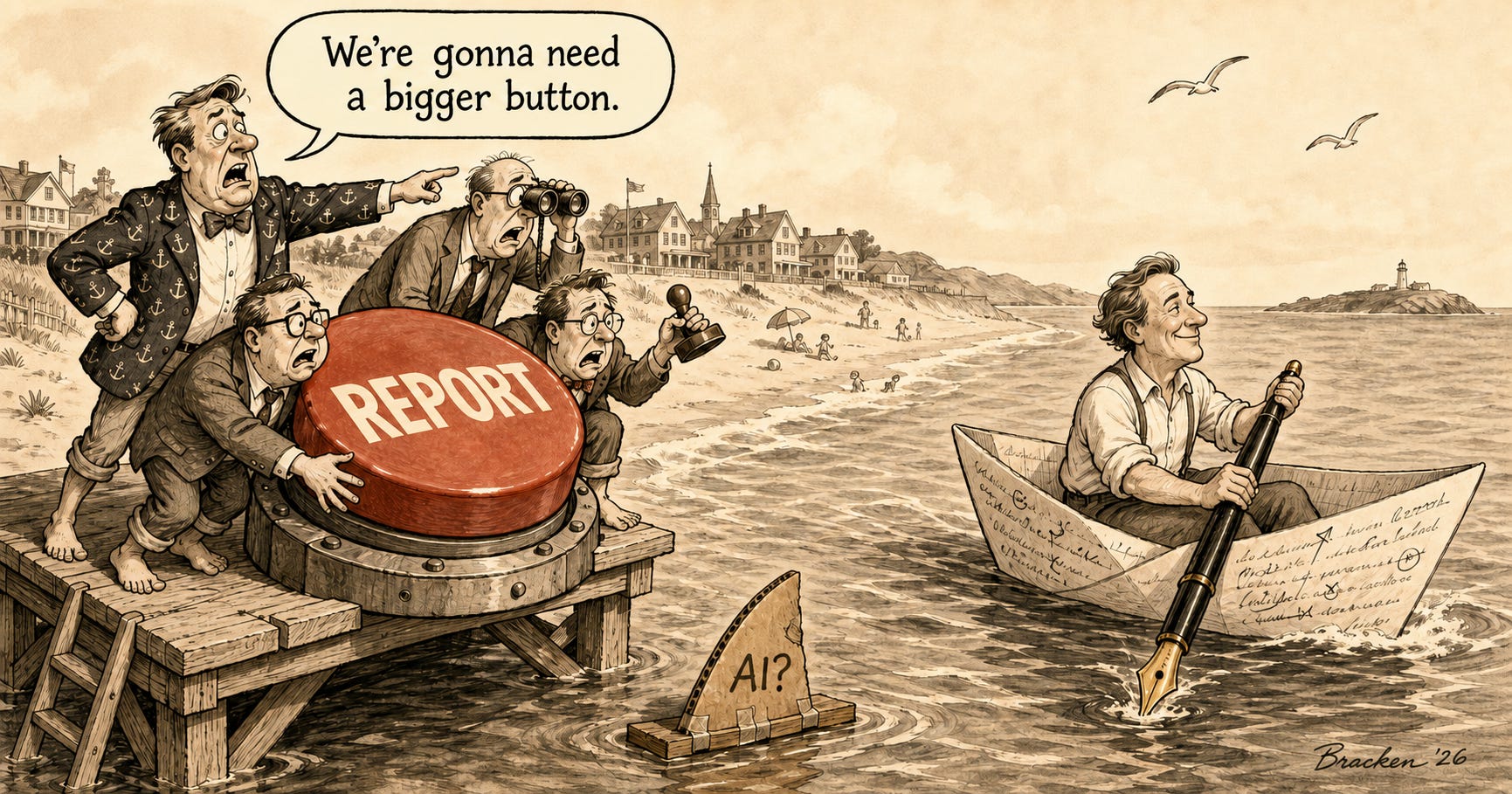
Not that it was AI slop. Nobody has to establish that. Nobody has to establish anything. The report button shipped at the end of July, hiding under the three-dot menu like it had always been there, and it does not say “This is AI-generated.” It says the post seems like AI slop. A report button for a feeling. Read that word again, because the entire machine balances on it. “Is” would be a claim, and a claim can be wrong. “Seems” cannot be wrong. You can’t disprove somebody’s impression of your writing – and this summer, their impression got machinery. A million members clicked it in the first three weeks, every one of them quietly feeding the software that decides what the rest of us see next.
There’s a scene in that movie everybody remembers. Fourth of July, beaches open, the mayor personally coaxing a family into the surf so the tourists will follow. Brody has already sent his own son to the pond, a sleepy backwater the boy complains is for old ladies. Do it for the old man, his father says. Then a fin cuts through the swimmers, and a packed beach empties in about ninety seconds. Amity answers with everything it has. Patrol boats converge. Deputies lean over the side with rifles trained on the fin, and they are about to fire when two terrified boys pop up holding a piece of cardboard. Guns drawn, on cardboard, held by children. And while every eye and every barrel on that beach points at the fake fin, the real shark slips through the inlet into the pond – the water for old ladies, the water the police chief himself chose because it was safe – and takes a man off a rowboat.
That scene – both halves of it – is this entire summer. The panic requires no verification. The enforcement, when it shows up, shows up armed and aims at the wrong thing. And the real bite happens in the boring water nobody is watching.
Because here’s the thing about monster movies: the monster is never the story. The town is the story. Jaws is not about a shark – it’s about Amity, a town deciding what it’s willing to see. So this isn’t really an essay about AI.
It’s about the town.
* * *
There’s another scene people forget. Halfway through the movie, the town catches a shark. They string it up on the dock and pose for pictures, and the mayor declares the beaches safe. The scientist wants to cut the shark open to be sure it’s the right one; the mayor won’t hear of it – not with cameras on the dock. Verification is bad for tourism. It is, of course, the wrong shark. The one doing the biting is still in the water.
That’s the whole argument, right there on the dock. Slop is real – the feeds genuinely are filling with careless, worthless posts, and I’m not here to tell you your eyes are lying. But the town has strung up the wrong animal. Slop was never an AI invention. Bad writing predates the chatbot by about five thousand years. So does spam. So does plagiarism, padding, phoning it in, and publishing garbage while calling it done. AI made carelessness faster and nearly free, and the flood that followed is real – but a flood of an old thing is not a new thing. The monster the town wants is the machine. The monster it has is the one it’s always had: a person who hit publish without caring what went out.
AI doesn’t publish slop. Humans do.
Everything else in this piece – the buttons, the scanners, the invisible marks, the write-ups – is the town on the dock, posing with the wrong fish.
* * *
Let’s meet the town council. The mayor of Amity spends the whole movie in a blazer printed with little anchors, reminding reporters that Amity means friendship, keeping the beaches open because summer dollars are summer dollars. LinkedIn’s entire brand is connection. Friendly towns with something in the water reach for the same playbook: deny the problem while the money is swimming, then, once the crowd turns, punish it as theatrically as possible.
So here’s LinkedIn’s product chief, this summer, mid-turn. He says AI slop is “a top priority for all of us.” He also says “AI and slop are not the same thing.” He also says “slop is hard to define and the definition changes” – adding, helpfully, that your reports let them tune their models. Stack those up and enjoy the view. It’s a top priority. It isn’t the same thing as AI. And nobody can define it – but the reports become the definition, and the enforcement is already live. Definition later. Harpoons now.
Oh, and in the same announcement, LinkedIn killed “Enhance your post” – the AI writing assistant LinkedIn itself bolted into the compose window, the one that spent two years helping fill the very feed now under suspicion. The company didn’t just step on the rake. It manufactured the rake, handed one out free with every profile, and then installed a button for reporting anyone seen holding one.
One more detail from the fine print. LinkedIn says it built safeguards so that individual feedback can’t be used to “unfairly target other members.” Sit with that. They poured the guardrail before most members knew the button existed. You don’t pour concrete at the edge of a cliff nobody is driving toward.
* * *
When Amity finally admitted it had a problem, it didn’t send for experts. It posted a bounty – and by morning the harbor was wall-to-wall amateurs in overloaded boats, jostling for a shot at a monster none of them could identify. That’s the button. A billion members deputized overnight, no training required, no definition supplied.
And since nobody agrees on what slop is, everybody hunts by folklore instead: em dashes, emoji bullets, thirty one-sentence paragraphs in a row, the word “delve.” The surface tics get reported, never the substance. It is the smallest hill in publishing, and people are dying on it daily. The reports train the detection software, and the verdict now costs real money: LinkedIn says members are seeing 40% less of what it classifies as AI slop than they did a few weeks ago – a number the company brags about while declining to say how much your clicks actually caused. So writers do the only rational thing – they scrub the tics. And here the loop closes on something genuinely strange. “Human writing” quietly stops being something the software detects and becomes something the software defines. Whatever doesn’t get flagged, that’s human. A property invented by the button, with a price tag attached.
I’m Exhibit A. I banned em dashes from my own writing months ago. Not because anything is wrong with an em dash – I used them happily for decades – but because I now publish into a world where a stray dash is treated as evidence, and I’d rather lose a punctuation mark than argue with a feeling. You won’t find a single one in this essay. I wish I could tell you that was a style choice.
* * *
Here’s where I’m supposed to concede that all of this is really about quality. So let’s test that.
Long before AI entered the picture, I quietly accumulated more than a dozen free years of credit monitoring – parting gifts from companies whose human-coded, human-designed, human-approved apps leaked my personal information to hackers. My identity has been stolen twice. Both times, the ceremony was identical: an email mentioning that my records had wandered off along with a few hundred million other people’s, a coupon for credit protection, and a warm suggestion that I contact the bureaus. That was it. That was the whole reckoning. No mark. No scanner. No reach penalty. There is no “seems like negligent engineering” button on the App Store.
An em dash on LinkedIn now draws more organized outrage than a database breach. The breach got a news cycle and a settlement; the punctuation got machinery. And I understand why, sort of. You can spot an em dash from your towel in two seconds. You cannot see careless engineering from anywhere on the beach. Outrage flows toward whatever’s easy to see, not whatever does the damage. Sharks got a theme song. Riptides just get you.
Whatever safeguards those companies had, my information got out. Humans built the apps, humans shipped them, and I got the credit-monitoring coupon – years before there was a chatbot to blame. The breaches were the pond. The real bite always happens in the water everyone agreed was safe, while the boats surround a fin.
* * *
So here is my definition of slop, and notice that it never mentions the tool: slop is what happens when nobody sets a standard going in, nobody checks the work while it’s being made, and nobody reads it before hitting publish. Made without care, reviewed by no one, shipped anyway. The emoji-bullet spam everybody pictures absolutely qualifies – not because an AI touched it, but because no human did.
Run two essays through that test. One is brilliant, argued to the bone, written with an AI in the room the entire time, draft after draft. The other is terrible, hand-typed, every cliché lovingly selected by human fingers. The “AI touched it” standard convicts the first. Mine convicts the second. The internet convicts whichever one it’s mad at today, and calls that a standard.
I recently sat a timed technical interview built entirely around working with AI – using the tools was the point. In the first few minutes I had the machines generate quick, working answers, which I saved as insurance in case the clock or the platform betrayed me. Then I spent the next five hours doing the actual work: running multiple AIs against each other, making them critique each other’s output, rewriting, testing, throwing drafts away, until the solutions were something I’d sign my name to. The hours weren’t what made the work better. The decisions I made during them were. Same tools produced the panic drafts and the finished work. Same invisible watermark on both, if anybody checked. Everything that separated them was care – and care is invisible to every detector being built.
* * *
Which is why the new disclosure regime is so strange once you step back from it.
Substack – of all places, the home of the independent writer – now runs an optional AI-detection scan on posts and shows a “how I make this” statement beside the score, a little box where the author explains their process. I keep staring at that box, because I cannot find the precedent for it. No creator, in any medium, at any point, has been expected to file a methods statement alongside the work. I’ve watched making-of features where the actor was the only real object on set – the floor green, the ceiling green, the coffee cup green – and when the movie plays, no warning slides up to tell you the room was fake. We just call that filmmaking.
Publishing goes further. There’s an entire respectable industry – agencies, rate cards, invoices – in which somebody else writes the whole book and the person who paid gets their name on the cover. Memoirs, business books, political autobiographies. The ghostwriter signs away the credit as a term of the deal, the reader is never told, and the cover says “by” somebody who may never have opened the document. We don’t scan those books. We don’t score them. We put them on bestseller lists and invite the “author” on television to discuss their writing process. A hundred years of readers believing one person wrote what a different person actually wrote, and nobody has ever aimed a rifle at the memoir aisle. But tighten your own paragraphs with AI, under your own name, and there’s a box to fill out and a score beside your byline.
Books even have a disclosure page already. It’s called the acknowledgments: “to my editor, who made this book what it is” – a thank-you nobody audits, cheerfully papering over killed characters and rewritten endings, and here is the important part: the author decides who makes the cut. Disclosure has existed forever, as gratitude.
This summer it got reinvented as an alibi. Watch the ladder we’re climbing. First the acknowledgment: voluntary, and yours. Then the how-I-make-this box: invited, expected, increasingly assumed. Then the watermark: compelled and invisible. Then the button: not yours at all – someone else’s, aimed at you. Each rung less voluntary than the last. By the bottom rung the work no longer gets read first. The writer gets authenticated first.
The watermark deserves its own paragraph, because most people don’t know this is happening. AI companies are beginning to mark generated content, and more are likely to follow with versions of their own. In text, a mark can be woven into word choices, invisible to the reader and detectable through a system the company controls. The more words the machine chooses, the more room there is for the mark. Ghost-write with it and the signal comes through loud; proofread your own page and there may be too little to even register. The stamp measures dose, not care. It can tell you the machine was in the room, never whether anyone was minding the work. Even the FDA, the most label-happy agency we have, only makes you list ingredients. There is no law requiring soup to declare “a food processor was used in the making of this soup.” We built the equipment label anyway, and the town reads it as a contamination warning.
And look – if you personally prefer work made without AI, that is a completely legitimate taste. Like vinyl. Like hand-thrown mugs. Enjoy it proudly, seek it out, pay extra for it. Just buy it as a preference. Don’t launder it through the word “slop.”
* * *
We have run this play before, recently. From 2020 to 2022, suspicion became a label, the label became a button, the button became a consequence, and “don’t read it, report it” became a civic virtue. Both political tribes ran the same move – “fake news” was the identical machine with the polarity reversed – and the biggest platform on earth banned posts calling the virus man-made in February of 2021, then un-banned them that May when official investigations reopened the question. The virus’s origin didn’t change in those three months. The classification did. But say this much for that era: misinformation at least claimed something about the world. It could, in principle, be checked. “Seems like AI slop” doesn’t accuse you of being wrong about anything. It accuses you of a vibe.
We rebuilt the reporting machine and removed the part where something could be true or false.
And yes, before the comments write themselves: some of what’s washing up on the beach really is slop, by my definition and probably by yours. But take honest inventory of what one summer built – a button, a scanner, an invisible mark, a demerit, and reduced reach, all built around a label whose meaning is still up for grabs. Whatever the reasons – fear, taste, sheer exhaustion with the pace of change – a moral panic with a launch date is still a moral panic.
* * *
Substack’s CEO, to his credit, wrote the most honest sentence of the entire panic: “Not everything made with AI is slop, and not all slop is made with AI.” His worry is the reader who believed a person wrote something when no person did. Fair enough – but that is a disclosure question, and disclosure on the writer’s own terms is as old as liner notes. Offered, it’s liner notes. Demanded, it’s a deposition.
Because notice: this story has two buttons in it, and the town is staring at the wrong one. Slop never happens at the report button. It happens at the publish button – and behind every publish button, even the ones wired to a bot posting on a schedule, stands a human who decided no further care would be required. Somebody built that pipeline, aimed it at the feed, and walked away. The walking away is the slop. My definition says slop is what you get when the writer skips judgment. The report button lets the reader skip it too – outsourcing the verdict to a click and a piece of software. The entire regime built to punish absent judgment runs on absent judgment. Same disease. Both sides of the beach.
Here’s what history says happens next. Auto-Tune was a scandal until it was a genre – the same people reporting em dashes today will defend T-Pain to the death. Photoshop was cheating until it became a verb. The darkroom, the drum machine, the word processor: every tool panic ends the same way, with the tool going invisible and everybody back in the water. This panic will pass like all the others. Summers do – even the ones that pack the beach right up to the last day.
What we built to hunt it won’t. The buttons will still be mounted. The marks will still be sitting silently in the text years from now, readable to whoever holds the key – a fossil record of one summer’s fear. After Jaws, the men who made it watched shark-fishing tournaments boom and came to believe they’d helped load the harpoons – Spielberg has said he regrets it, and Benchley spent his final decades campaigning for the animals he’d made monstrous. The fear faded. The dead sharks stayed dead. We’re building the version of that you can’t undo with an apology.
But remember who actually solves it in the movie. Brody hates the water. That’s the joke of him – a police chief afraid of boats, marooned on an island. And when the bounties and the dock photos and the beach patrols have all failed, the answer isn’t one more report filed from the sand. It’s the guy who gets in the water anyway and does the work himself, all the way to the end. Everybody remembers the famous line about needing a bigger boat, and everybody remembers it as a line about the shark. It’s really a line about the response. When the thing in the water gets bigger, the answer is not a louder beach. It’s more nerve, more judgment, more care.
So let them mount the buttons and stamp the marks and write us up. I’m not going to sit on the sand reporting fins. I’m going to keep choosing my tools, doing the work, and proudly putting my name on what I create. Read it, argue with it, tell me where it falls short. Great – that’s a conversation worth having, and I’ll be right there having it with you.
Spielberg made Jaws with a broken machine named Bruce. But what mattered was that he knew what to show, what to leave out, and how to make the audience feel it.
See you in the water.