


The recent coverage of Copilot’s slow adoption has focused on familiar explanations: pricing resistance, unclear value, enterprise caution, change management. Those factors are real, but they are surface symptoms. They don’t explain why Microsoft’s AI efforts feel less convincing than they should, given the company’s scale, talent, and access to some of the most advanced models in the world.
The deeper issue sits lower in the stack. Microsoft has invested heavily in intelligence, but far less successfully in the conditions that allow intelligence to become indispensable. What users are reacting to is not a lack of capability, but a lack of cohesion. AI appears in Microsoft’s products as something added, rather than something assumed. It shows up as a panel, a button, a suggestion, a helper, not as the organizing principle of the experience itself.
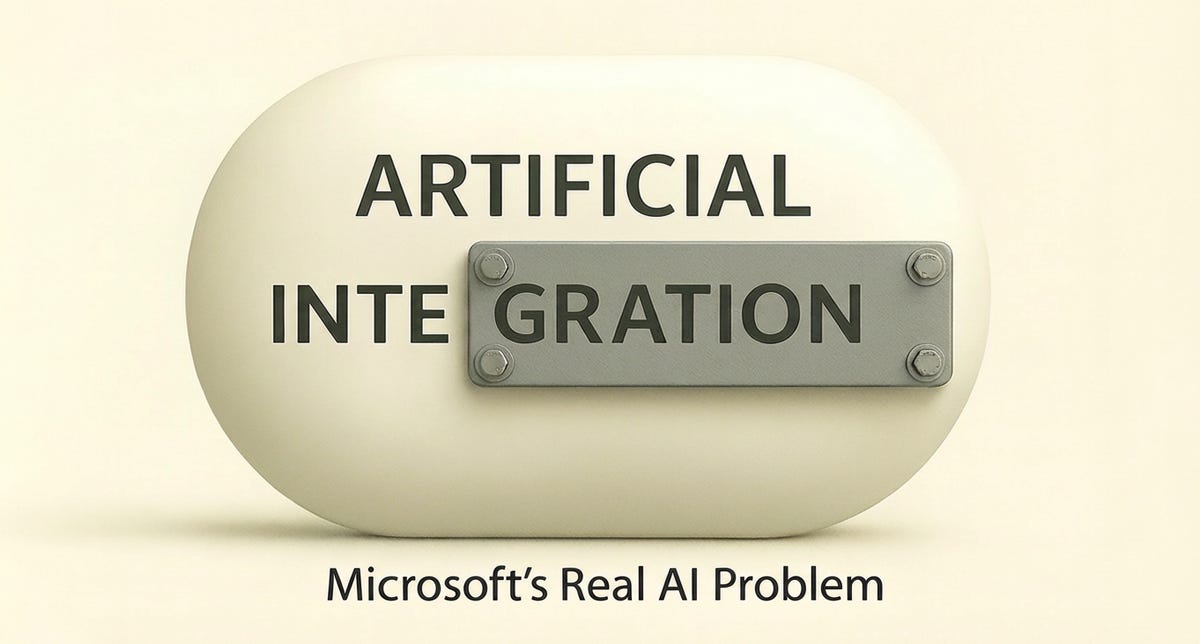
This is where the idea of Artificial Integration stops being a clever phrase and starts being a diagnosis.
When Work Had a Starting Point
For most of Microsoft’s history, its strength came from owning the starting point of work. You opened Word because that was where documents began. You opened Excel because that was where analysis lived. Windows and Office were not just tools, they were defaults. Productivity flowed inward toward the platform.
Generative AI has reversed that gravity. Today, many people begin with intelligence first and worry about format later. They open ChatGPT or Claude to think, draft, summarize, or structure ideas before deciding whether a document even needs to exist. When AI sits outside the application, the application loses its privilege. Integration becomes the difference between relevance and bypass.
For most of the software era, tools defined how work happened. Interfaces imposed structure, and users adapted. That model held for decades. What AI has changed is the direction of that influence. Workflows now shape tools, not the other way around, and conversational interfaces collapse that feedback loop almost instantly. When people can express intent directly, they stop tolerating systems that require translation, navigation, or indirection.
The Sidebar Problem
This is where Microsoft’s challenge becomes visible. Copilot often feels adjacent to the work rather than embedded within it. The experience suggests augmentation instead of authorship, assistance instead of orchestration. That may have been a reasonable compromise under intense time pressure, but it carries consequences. Once users experience AI as something separate from the core workflow, they start asking a simple question: why am I here at all?
What users increasingly expect is not an AI they consult, but an application that behaves intelligently by default. Conversation has become the new entry point for work. When intelligence lives somewhere else, in a panel, a sidebar, or a separate mental step, users feel the friction immediately. They are being asked to meet the system where it is, rather than the system meeting them where they already work.
This isn’t an argument that platforms should blindly follow users. It’s an acknowledgment that the interface for intelligence has shifted. Users still work inside applications, but they expect those applications to respond directly to intent – not to route intelligence through a separate step.
The Coherence Gap
The difficulty of unwinding these decisions is amplified by ecosystem realities. Apple and Google both benefit from something Microsoft no longer has: a cohesive, end-to-end environment where hardware, operating system, and intelligence evolve together. Apple’s decision to delay public AI commitments while reinforcing its hardware ecosystem now looks prescient. When Gemini enters Apple Intelligence, it will arrive in a system already designed to feel unified. The intelligence will not compete with the interface; it will inhabit it.
Google enjoys a similar advantage through Android and Pixel. Intelligence moves with the device, not alongside it.
Microsoft, by contrast, is integrating AI into a product surface that has become fragmented across devices, platforms, and contexts. Windows no longer functions as an operating-system moat. Office no longer defines the default starting point for knowledge work. Productivity has become more fluid, more conversational, and less bound to a specific application.
In that environment, AI that feels bolted on is easy to bypass.
Smart Enough, But Not Native Enough
This is why Copilot’s adoption challenges should not be interpreted as a referendum on AI’s usefulness. They are a signal that integration quality now matters as much as intelligence itself. Users do not reject AI because it is unfamiliar. They reject it when it feels optional, interruptive, or redundant with tools they already trust.
Microsoft still has formidable strengths. Azure remains one of the most significant infrastructure moats in the industry, and the company’s enterprise footprint is unmatched. But infrastructure alone does not create habit. Habit forms where work begins. And increasingly, work begins in conversation, not in documents.
Until AI becomes the place where work starts inside Microsoft’s ecosystem, not the place users visit after the fact, adoption will continue to lag behind capability.
Beyond the Bolt-On
Artificial Integration is not a branding problem or a messaging problem. It is the structural gap between intelligence and experience, and until that gap closes, capability alone will not drive adoption.
The companies that lead the next decade of AI will not be the ones with the largest models or the loudest launches. They will be the ones that design systems where intelligence feels native, inevitable, and inseparable from the work itself. Microsoft is still capable of being one of those companies. But that future depends on whether AI remains something it adds, or something it builds around.
Bruce Bracken is the founder of Artwell.ai and former Head of Podcasts & Digital Experiences at Microsoft, where he built a content ecosystem that generated $59M in attributed Azure revenue. He writes about the gap between what AI companies say and what humans actually experience.