


The realtor said the house had good bones and a beautiful staircase, and that nobody stayed. She said it brightly, the way people say a thing they have decided is charming. “Seven owners since the original family. Lovely people. They just move on.” Her phone was ringing again. She glanced at the screen, silenced it, handed Owen the key and pointed out the lockbox on the porch. “I’m so sorry, I have to run. Take your time, though.” He held the door for her, but she was already halfway down the steps.
He hadn’t told her he was the original family. He’d found the listing the night before and known the house from the first photograph. It was the ninth one, the staircase, that made him put his phone face down on the table, and it was a few minutes before he picked it up again and booked the appointment.
The front hall smelled of lemon polish, and the smell was wrong. The house had been staged – a gray sofa nobody had ever sat on, a bowl of wooden pears on a side table – and this was the smell of a house where someone polished every day. The banister shone. Halfway up, at the height of a child’s shoulder, a small handprint clouded the wood. Owen wiped it off with his sleeve before he had decided to. He stood there holding his cuff. Then he went upstairs.
On the fourth step his mouth filled with the taste of pennies. He touched his lip and checked his fingers and found nothing, swallowed a few times, and by the landing it was gone. His old room had a desk in it now, and a plant in a white pot. He waited to feel something and mostly felt the drive in his lower back.
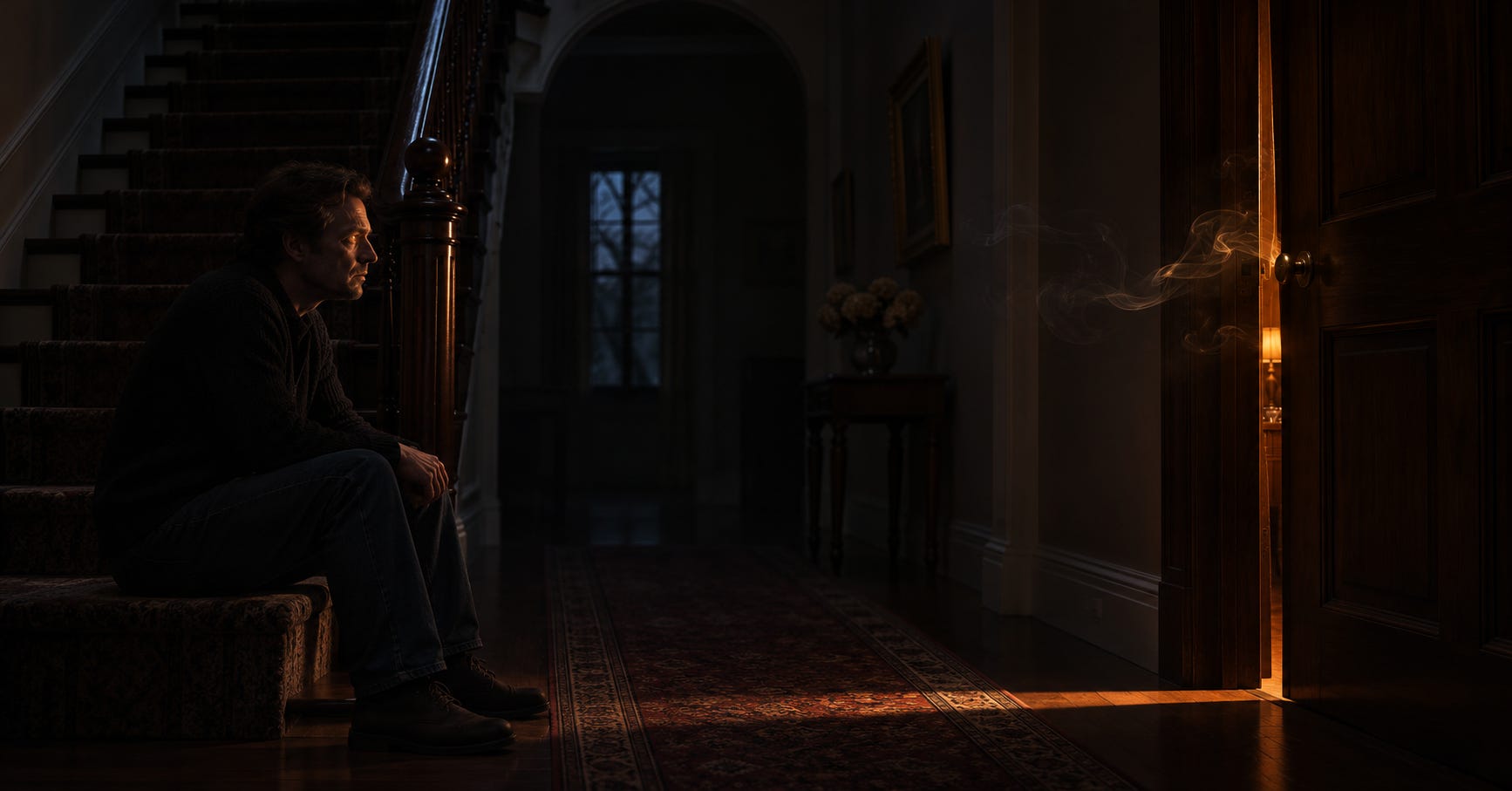
Coming down, he kept his hands off the rail. The study was across the hall from the foot of the stairs, and its door stood open about four inches. He knew that gap: the brass knob, the strip of darkness, the line of lamplight on the floorboards. As a boy he had stood in front of it with report cards and permission slips, trying to tell whether his father was looking up. Sometimes a hand came out for the paper. Owen would pass it through and wait to have it handed back.
He put his palm against the door and pushed. It gave a little, then stopped, and when he pushed harder something pushed back, steadily, until the gap was four inches again. When he took his hand away, smoke drifted through the opening – cedar and something sweet, the cigars his father bought by the box and smoked only in that room. The listing had said non-smoking. Non-smoking, pet-free, move-in ready.
From the top of the stairs, a child said, “Is it okay?”
*
The staircase was empty. “Hello?” Owen went up again, calling out that he was there with the realtor, that he hadn’t meant to startle anybody, and the copper came back on the fourth step and he climbed through it. Every bedroom door stood open. He checked each room and the bathroom and found no one. Someone had plugged a night-light into the outlet beside the top step, a little plastic shell. One of the families after his, he supposed. Somebody’s kid hadn’t liked the top of the stairs in the dark.
The carpet runner on the top step was pressed flat in a patch the size of a small seat, with two smaller marks in front of it where heels would go. He crouched and touched one. It was cold. When he straightened up, the handprint was back on the banister below him.
Downstairs he took out his phone. The realtor had sent a reminder about the lockbox. He typed, Is there anyone else in the house? and her answer came while he was still looking at the screen. No, just you.
At the front door he stopped and looked out. His car was where he’d left it. Across the street a man was hauling a trash bin up his driveway, wrestling it over the lip of the garage floor, and when he looked up Owen raised a hand, and the man raised one back. He could get in the car and call the realtor from the road, tell her something was wrong with the study door. Behind him a board creaked on the landing. His hand stayed on the knob a while longer, and then he closed the door.
“I’m down here,” he said, and sat on the bottom step. From there he could see the hall, the kitchen doorway and the four inches into the study. Nobody could come down the stairs without passing him.
The kitchen had been remodeled, but he could still place the table under the window and his mother’s chair nearest the sink. She had kept the lemon oil in the cupboard beneath it, in a brown bottle, and every night after dinner she polished the banister, working her way up to the landing. When he was little she gave him a piece of an old undershirt and let him do the bottom section, and he had been pleased to be trusted with it. Later, when he ran up the stairs, she followed with her cloth, wiping wherever he’d touched. Without thinking he rubbed his palms on his jeans. There had been a night. He could feel the shape of it the way your tongue finds a chipped tooth, and he had never been able to get any closer than the shape.
Outside the light was going. He hadn’t turned on any lamps, but a thin line of yellow showed beneath the study door, and at the top of the stairs the night-light had come on.
*
A cabinet shut in the kitchen, and then came his mother’s voice, the particular not-loud of someone who has decided to be furious quietly. He couldn’t make out the words. His shoulders came up around his ears anyway.
Small feet ran past him and up the stairs, close enough that he felt the cold of them against his cheek, and a hand squeaked along the rail.
“I’ve just done that.”
Slippers crossed the hall, one of them scuffing at the heel. That sound he knew too; she never put the left one on properly. He tried to stand, but he was already making room for her, drawing his feet in against the bottom step, and the slippers went past. On the fourth step there was a sound like a book dropped flat on a table.
His mouth filled with blood. He pressed his hand to his lip and felt it wet, and when he looked, his fingers were clean. Above him someone was trying not to cry. Owen sat with his hand against his mouth until the slippers came down again and went back to the kitchen, and the small feet followed, more slowly, and crossed the hall, and stopped at the study.
“Dad.”
The smoke grew stronger.
“Dad. She hit me.”
A page turned.
“What did you do?”
“Nothing.”
“Owen.”
“I touched the railing. But I washed my hands. They weren’t –”
“Your mother works very hard on that railing.” Another page. “She’s had a long day. Go on up. We’ll talk about it when you’re calmer.”
The line of light under the door went out. They never had talked about it. Owen remembered waiting at the table the next morning while his father buttered his toast, watching for some sign that he was ready, and then his father asked him to pass the marmalade. The child stood at the dark door a few seconds longer. Then the feet came back to the stairs. Owen moved his knee out of their way. They climbed to the top, and he heard someone sit down.
He could see the boy now, in the weak glow of the night-light. Eight years old, in the striped pajamas with the cuffs let down, knees drawn up, one sleeve held against his mouth.
“Is it okay if I’m mad at her?”
Owen looked at the study door.
“Is it okay if I’m mad at him?”
In the kitchen, a drawer slid open.
*
The lemon came down the hall like water under a door, fresh and so strong it caught in his throat, and under it he heard the slippers, and the cloth moving along the banister. At the top of the stairs the boy took his sleeve away from his mouth, put both hands in his lap, palms up, and looked at them. Owen’s own fingers had gone to his pockets. That was how he had learned to climb these stairs after that night, with his hands out of sight.
The slippers stopped beside him. He had already sat through it once tonight. He stood up.
He climbed to the fourth step and turned around. The boy was behind him at the top, and below him lay the empty hall and the dark gap of the study. The first step creaked, then the second, and he held his breath as the third took her weight.
“Move.”
His right foot shifted toward the edge of the stair. He looked at the study. The gap was dark, and nothing behind it had made a sound, and he heard himself say to it, “I was just –”
He stopped. His back was against the wall, and there was room to get past him now. The third step creaked again. Owen moved back into the middle of the stair with his legs shaking, reached for the banister and closed his hand around it. Something cold caught his wrist. Fingers pressed through his sleeve, and he nearly let go; his mouth was already open to apologize. He kept his hand on the wood.
“No,” he said. “Not him.”
The grip tightened. His own breathing was loud in his ears, and behind him the boy’s sleeve moved against the carpet. He stayed where he was. For a long time there was only the pressure on his wrist and the smell of polish.
Then the grip loosened. He waited for it to come back. The stair below him gave a small creak, and the lemon faded until all he could smell was old dust from a heating vent. When he finally let go of the rail, his fingers left a damp print on the wood.
*
The boy watched him climb the rest of the way. Owen sat down beside him, leaving a little space, because he remembered not liking people too close, and for a while neither of them said anything. He rubbed the wrist where he’d been held.
“Is it okay?” the boy asked.
“Yes.”
The boy glanced toward the kitchen.
“You touched a railing,” Owen said. “She shouldn’t have hit you.”
“She’d just cleaned it.”
“I know.” He waited until the boy looked at him. “She still shouldn’t have hit you.”
The boy let his knees down a little. There was a loose thread at the cuff of his pajamas, and he wound it around one finger.
“Dad didn’t hit me.”
Owen looked down at the study. His father had been up since five. He nearly said it. It was what he had told other people for years, whenever they asked about his father.
The boy kept winding the thread.
“He could hear you,” Owen said instead. “He should have come out.”
“Are you mad at him?”
He took a breath and caught the smoke again, faint, from the bottom of the stairs.
“Yes.” He waited. Nothing happened behind the door. “I am.”
The boy unwound the thread from his finger. Owen rested a hand on the stair between them, wanting to put an arm around the boy and not doing it, and after a while he said, “You don’t have to ask anybody. Not even me.”
The boy didn’t answer. After a minute Owen felt small fingers rest against the back of his hand, and he sat with them there until he could no longer feel them. When he looked over, he was alone, and the pressed carpet beside him was slowly rising.
*
Downstairs he stood outside the study with his hand on the knob, then pushed. The door opened all the way. There was a radiator under the window and nothing else in the room, and the cigar smell was gone. Four dents were still pressed into the oak floor where a heavy chair had stood. He went in, drew the door almost shut behind him and crouched where the chair had been. Through the four inches he could see the fourth step. He stood, pulled the door wide and left it open.
On his way out he stopped at the banister. Halfway up, at the height of a child’s shoulder, a small handprint clouded the shine. He put his hands in his pockets, then took them out again.
He left it there.